
1. AI writing has a look, and reviewers are learning it
This came up on a case study that was visually strong but read like it had been heavily machine-drafted. Eyebrow headers with numbered prefixes. “It is not X, it is Y” constructions. Em dashes everywhere — including from hosts who now avoid them because they have become an AI tell.
None of that means you cannot use AI. It means the output needs an editing pass in your voice. If a hiring manager cannot tell what you actually think, they will not credit you for the thinking.
Practical fix: strip the template phrasing, drop decorative section labels that do not aid navigation, and replace tool credits (“Made with…”) with a sentence about your process instead.
2. The design engineer title is having a moment — for better and worse
Several candidates are positioning between design and front-end implementation. That is a real and valuable lane. It is also getting crowded with people who use AI to produce code-shaped output without the underlying engineering judgment.
If you claim design engineering, your portfolio needs to show how you make implementation decisions — not just that you shipped something that compiles. Otherwise you read as “designer with AI-generated front-end,” which is a different and much weaker signal.
3. Senior UI work is not disappearing — the surface is
We spent time on a hot take that keeps landing in chat: AI is eating more of the tactical UI layer than research or strategy. That does not mean UI designers are obsolete. It means the differentiation moves upstack — to framing problems, choosing constraints, and directing tools (including AI) toward an outcome.
If your goal is senior-level UI, the portfolio needs to show strategic language, not just polished screens. What changed for the business or the user? Why this direction and not another?
4. Agency vs. product is still a positioning problem
Centralized studio teams and embedded product teams want different things. Studios often hire for depth in a specialization. Product teams often need a generalist who can own research through validation on one surface.
We walked through this with candidates torn between agency craft and in-house ownership. Neither is wrong. But a portfolio optimized for one will underperform for the other. Pick the formation you are targeting and let the work argue for it.
5. Referrals beat applications — your about page is part of the strategy
The best path into most companies is still a referral, not a cold apply. That makes the “future peer” audience real: people who might vouch for you after seeing how you think and who you are.
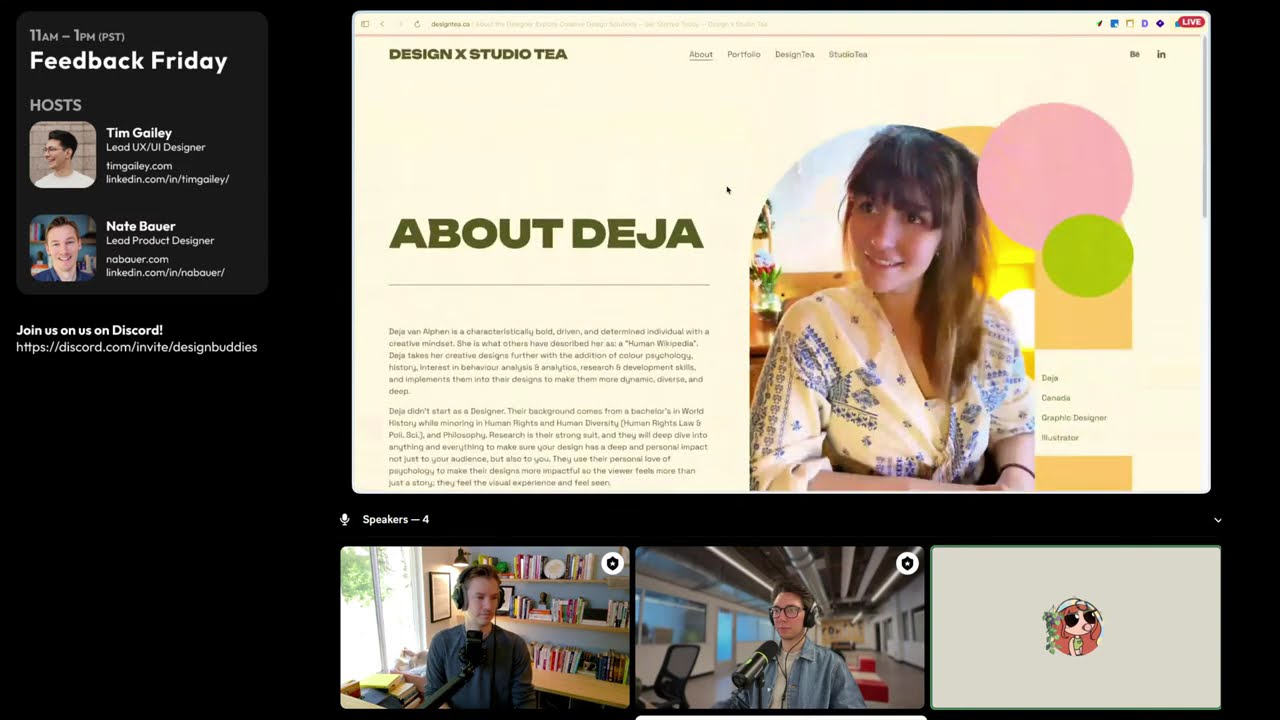
About pages matter more than most candidates treat them. Less corporate bio, more personality — enough that someone can imagine working next to you. Photos, hobbies, voice. It is closer to a dating profile than a résumé appendix.
We also looked at Framer-built student portfolios, illustration galleries that needed clearer case-study framing, and a few résumés where adding bullets and cleaning up title formatting would materially help ATS ranking. Same rules as always: more signal, less ambiguity, show the thinking.


